AI & Machine Learning Engineer

Diego Armando Salinas

I build machine-learning systems end to end: the model, the API, the interface, and the cloud they run on.

I studied mechatronics at Tecnológico de Monterrey and an MSc in Artificial Intelligence with Distinction at Essex. I work on Generative AI at SAP, and I founded ARMATUS, a training coach on iOS.

Diego Armando Salinas Lugo, AI & Machine Learning Engineer
SAP
Generative AI in production
Current role
ARMATUS
Founder · shipped on iOS
Current
MSc Artificial Intelligence
University of Essex
Distinction
Monterrey, MX
Open to US and remote roles
TN visa eligible

Work

17 projects

Selected work

Five systems that shipped. Metrics are test-set unless noted. Healthcare projects are research, not medical devices.

  1. ARMATUS

    Founder · Production · NLP / LLMs

    Live

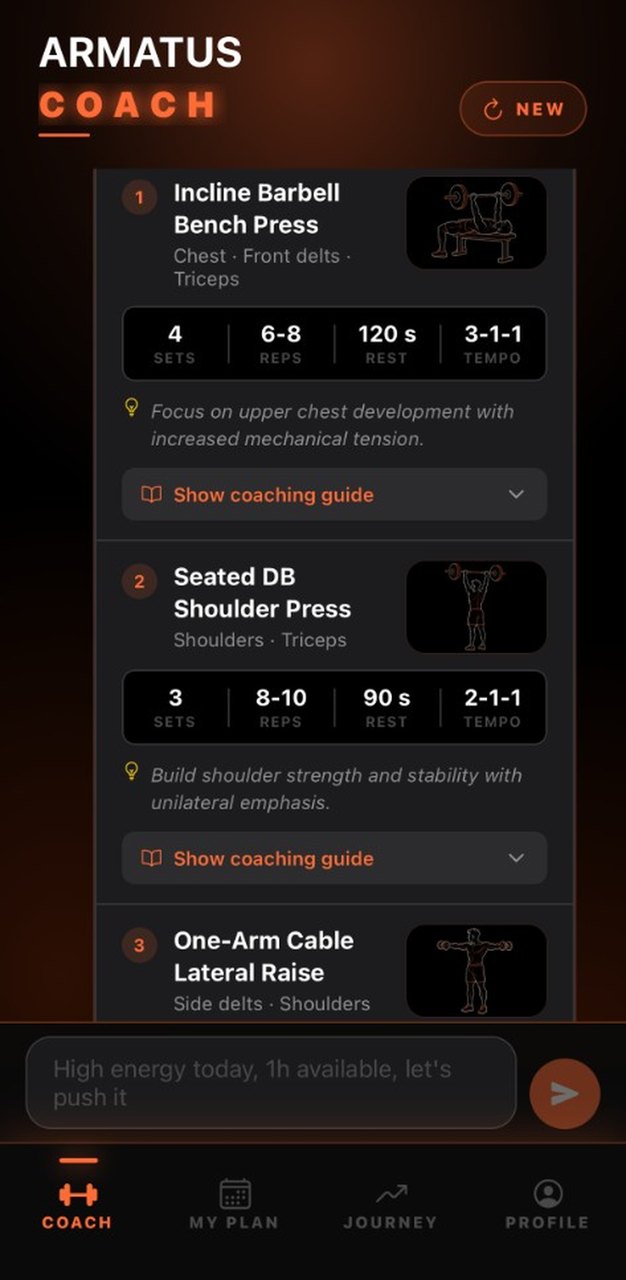
    An iPhone coach that architects the training week — not a template you tap through.

    Generic training apps serve static lists. They ignore equipment, injuries, sleep, and the fact that a long run on Wednesday is load on the same nervous system as Thursday's squat. Athletes who train seriously end up in a spreadsheet.

    A closed five-step protocol: calibrate the athlete, map overload, check readiness before load, dose the day, log against a technique standard. Each new week is regenerated from logged PRs and accumulated fatigue, with running and cycling counted as real load rather than a footnote.

    iOS
    shipped app
    5-step
    closed protocol
    ES / EN
    bilingual

    TypeScript · iOS · Generative AI · Streaming API · Design system

  2. COAZON

    Founder · Healthcare AI · NLP / LLMs

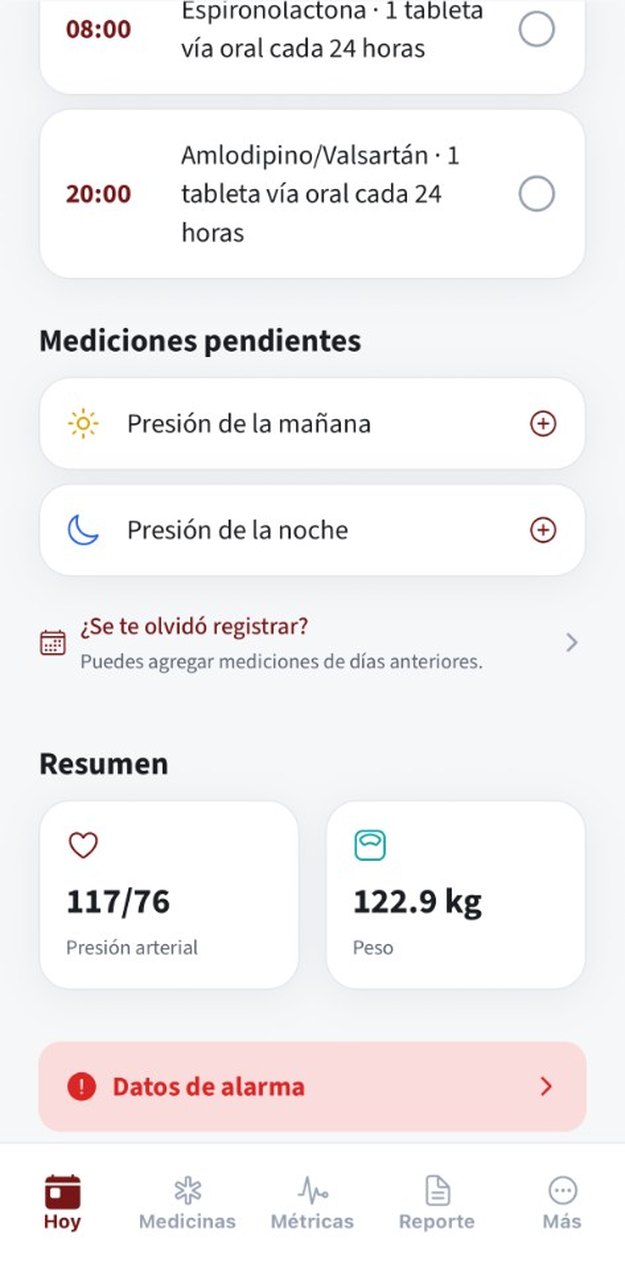
    A cardiologist's prescription, turned into a care plan a family can actually follow.

    After a cardiac event, the hospital discharges a family with a paper prescription, a blood-pressure cuff, and a list of warning signs they will not remember at 2 a.m. Existing health apps either nag on a rigid schedule or quietly start diagnosing.

    Built after a health scare in the family. Flexible medication reminders, a vitals diary charted by clinical zone, a deterministic red-flag alarm wired to an emergency screen, and a doctor-ready PDF for the next appointment. The AI layer is bounded on purpose — it reads prescriptions and writes summaries, and never diagnoses, prescribes or changes a dose.

    7
    milestones, 6 complete
    0
    AI diagnoses by design
    ES / EN
    bilingual

    FastAPI · SQLAlchemy 2.0 · PostgreSQL · Alembic · JWT auth · React Native

    In development — App Store polish stage. A logging and reminder tool, not a medical device: it never diagnoses, prescribes or recommends. Private repository.

  3. Engines Health Monitor

    Predictive Maintenance · Production · NLP / LLMs

    Live

    Fleet remaining-useful-life you can query in English — and download as a briefing.

    A remaining-useful-life number in a notebook does not help a maintenance planner. They need a fleet view, a reason the model fired, a conversation they can have without opening Python, and a PDF they can take to the hangar.

    XGBoost predicts remaining useful life on NASA C-MAPSS turbofan data, with SHAP attribution per sensor. A FastAPI service sits behind a Streamlit fleet dashboard, and a LangGraph agent layer answers diagnostics in plain English and writes the maintenance briefing as a PDF.

    16.74
    test RMSE (cycles)
    12.33
    test MAE
    0.825
    test R²
    15.02
    val RMSE

    XGBoost · SHAP · FastAPI · Streamlit · LangGraph · OpenAI

  4. Motor Performance Monitoring

    Predictive Maintenance

    Interpretable machine health from vibration and temperature — and a first place for it.

    A plant already has a preventive-maintenance procedure. The useful question is not 'can we train a neural net on this motor' — it is how you improve a procedure people already run, on two machines that do not sound the same, without an alarm they cannot explain.

    Profiles two very different machines — an induction motor baselined across five speeds and a Haas Mini Mill baselined from operational trajectories — then applies machine-specific adaptive thresholds. Deliberately rule-based, not ML: every alarm traces back to the statistic that fired it, which is what a maintenance team can audit.

    1st
    Tec Expo Ingenierías
    2
    machine types profiled
    5
    speed baselines
    0–100
    health score

    Python · Streamlit · Signal processing · Serial / IoT · Statistical thresholds

    First place at Tec Expo Ingenierías, the Tecnológico de Monterrey engineering project competition. Recognized by Rockwell Automation for contribution to an integration project using their technology (Nuevo León, Dec 2025).

  5. HRV Emotion Recognition

    Healthcare AI

    From raw PPG to emotion models under leave-one-participant-out.

    Emotion from the face is a solved demo. Emotion from the pulse, on a stranger the model has never seen, is a harder and more honest question — and the one a wearable actually has to answer.

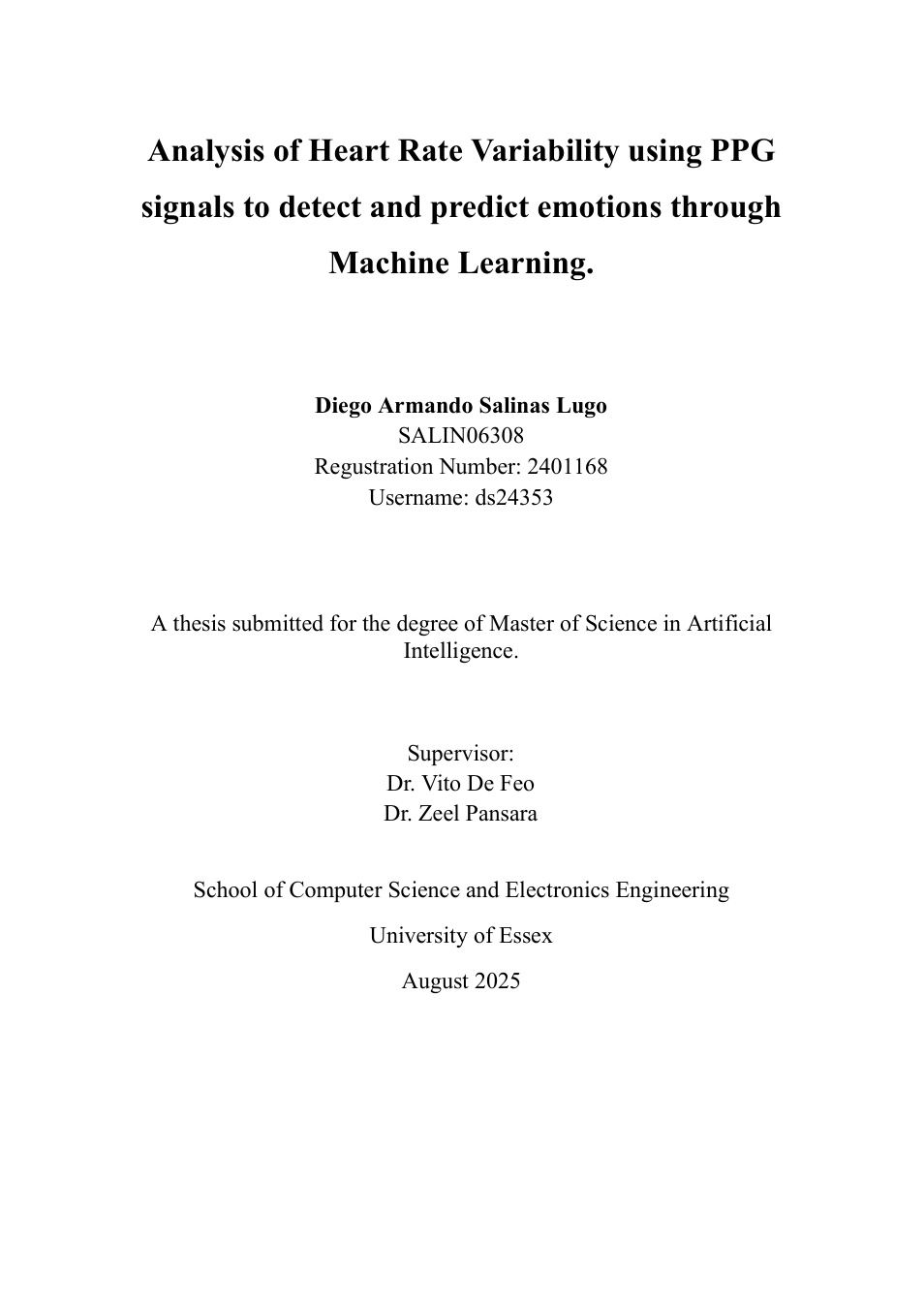
    MSc thesis. Butterworth filtering and IBI extraction feed time, frequency and non-linear HRV features, normalized against a calibration baseline. Validated leave-one-participant-out across 62 people, so the model has to generalize to a stranger rather than flatter a pooled score.

    0.5975
    Pearson r (arousal)
    0.154
    RMSE ± 0.032
    62
    participants

    Python · NeuroKit2 · SciPy · scikit-learn · Signal processing

    MSc Artificial Intelligence thesis, University of Essex — Random Forest, LOPO validated. Awarded Distinction.

ArchiveAll 17 projects, filterable

17 projects shown for All.

  • ARMATUS

    FounderProductionNLP / LLMs

    An iPhone coach that architects the training week — not a template you tap through.

    ARMATUS is a consumer iOS product built around a closed protocol: Calibrate → Plan → Adapt → Execute → Evolve. Deep onboarding (goals, equipment, injuries, schedule, lifestyle, external sports) becomes the athlete model. Each week is generated with an overload map and an explicit rationale — then the daily coach doses the session against energy, sleep, time and a readiness ceiling, so the plan yields to capacity rather than ego. The tracker logs sets against a technique standard, with sketches for setup, breathing and common errors. Journey stores PRs, volume and hybrid-sport load as the dataset the next week is regenerated from. Running, cycling, swimming and triathlon enter the algorithm as real fatigue, not a note in the margin. Spanish and English from day one. Production mobile app plus a streaming API for structured plan generation.

    iOS shipped app5-step closed protocolES / EN bilingual

    TypeScript · iOS · Generative AI · Streaming API · Design system

  • COAZON

    FounderHealthcare AINLP / LLMs

    A cardiologist's prescription, turned into a care plan a family can actually follow.

    COAZON turns a doctor's prescription into a living household plan: flexible medication reminders that tolerate a real day, a guided blood-pressure and vitals diary with trend charts marked by clinical zone, a deterministic red-flag alarm engine wired to an emergency screen, and a doctor-ready PDF for the next appointment. The AI layer is deliberately bounded — it reads prescriptions, accepts natural-language logging and writes descriptive summaries, but never diagnoses, prescribes or changes a dose, and every health answer defers to the treating physician. With no API key configured it degrades to fully manual and the app still works. Spanish-first and bilingual from day one, because that is the household it was built for. FastAPI and PostgreSQL on the server; React Native (Expo) on the client.

    7 milestones, 6 complete0 AI diagnoses by designES / EN bilingual

    FastAPI · SQLAlchemy 2.0 · PostgreSQL · Alembic · JWT auth

    In development — App Store polish stage. A logging and reminder tool, not a medical device: it never diagnoses, prescribes or recommends. Private repository.

  • Engines Health Monitor

    Predictive MaintenanceProductionNLP / LLMs

    Fleet remaining-useful-life you can query in English — and download as a briefing.

    An end-to-end predictive-maintenance service on NASA's C-MAPSS turbofan degradation data. XGBoost estimates remaining useful life per engine; SHAP attributes the prediction back to individual sensors so a technician can see which reading moved. FastAPI serves inference; a Streamlit dashboard is the fleet surface. On top of that, a LangGraph multi-agent layer answers diagnostic questions in plain English and writes a ReportLab PDF maintenance briefing. The whole stack is deployed on Google Cloud Run, so the demo is the production shape, not a local screenshot. Test RMSE 16.74 cycles, MAE 12.33, R² 0.825.

    16.74 test RMSE (cycles)12.33 test MAE0.825 test R²15.02 val RMSE

    XGBoost · SHAP · FastAPI · Streamlit · LangGraph

  • Personal Research Assistant

    NLP / LLMsProduction

    Chat with your PDFs. Every answer shows the snippet it came from.

    A retrieval-augmented generation service: upload a PDF, chunk at 1000 tokens with 100-token overlap, embed with text-embedding-3-small, store in Chroma, retrieve through a MultiQueryRetriever, then answer with GPT-4o grounded only in those chunks — sources always visible. Built and tested against the HRV thesis itself, indexed to 149 segments covering features such as RMSSD and pNN50. FastAPI behind a Streamlit client, so the same pattern can sit in front of any document set, not only this one.

    149 indexed segments1000/100 chunk / overlap100% answers cite source

    FastAPI · LangChain · ChromaDB · GPT-4o · text-embedding-3-small

  • ADHD & Sex Prediction

    Healthcare AI

    Screening support with fairness and explanations, not a black box.

    1,213 participants. Mutual-information feature selection, KernelPCA and stratified splits feed a Random Forest for ADHD and Logistic Regression for sex, with the sex model tuned toward female recall. LIME and SHAP carry the explanations so a finding can be inspected, not only scored. Fairness is reported by sex on purpose. ADHD accuracy 82%, recall 0.88–0.90, AUC 0.866; sex recall 0.71 male / 0.48 female — the gap is on the page, not in an appendix.

    82% ADHD accuracy0.88–0.90 ADHD recall0.866 ADHD AUC0.71 / 0.48 sex recall M / F

    scikit-learn · XGBoost · Keras · SHAP · LIME

    Academic research. Not a clinical device.

  • Cardiovascular Risk Classification

    Healthcare AI

    Leak-free clinical ML — and proof that a pooled AUC can lie.

    920 patients across four sites. Sentinel zeros in cholesterol and resting blood pressure are mapped to NaN, and the ColumnTransformer lives inside cross-validation so nothing leaks from the held-out fold. HistGradientBoosting is selected on recall then F1, explained with SHAP and LIME. Leave-One-Site-Out then exposes the transportability gap the pooled score hides: test ROC-AUC 0.90, recall 87.3%, F1 0.85 — LOSO mean AUC 0.79, worst site ≈ 0.70. Top drivers: asymptomatic chest pain, oldpeak, exercise-induced angina.

    0.90 test ROC-AUC87.3% recall0.85 F10.79 LOSO mean AUC

    scikit-learn · HistGradientBoosting · SHAP · LIME · ColumnTransformer

    Educational. Not a validated clinical instrument. Worst-site AUC ≈ 0.70.

  • Motor Performance Monitoring

    Predictive Maintenance

    Interpretable machine health from vibration and temperature — and a first place for it.

    An industrial preventive-maintenance system built around live vibration and temperature. It profiles two very different machines — a Sumitomo three-phase induction motor baselined across five speeds (50/60/75/90/100%) and a Haas Mini Mill baselined from combined operational trajectories — then applies machine-specific adaptive thresholds, because a milling machine is legitimately noisier than a motor. A threaded serial reader with auto-reconnection feeds the sensors into 0–100 health scores in a Streamlit dashboard, with replay mode for demos without hardware and live packet/FPS diagnostics. Deliberately rule-based rather than ML: every alarm traces back to the statistic that fired it, which is what a maintenance team can act on and audit. First place at Tec Expo Ingenierías; recognized by Rockwell Automation for contribution to an integration project using their technology (Nuevo León, December 2025).

    1st Tec Expo Ingenierías2 machine types profiled5 speed baselines0–100 health score

    Python · Streamlit · Signal processing · Serial / IoT · Statistical thresholds

    First place at Tec Expo Ingenierías, the Tecnológico de Monterrey engineering project competition. Recognized by Rockwell Automation for contribution to an integration project using their technology (Nuevo León, Dec 2025).

  • HRV Emotion Recognition

    Healthcare AI

    From raw PPG to emotion models under leave-one-participant-out.

    MSc thesis at the University of Essex. Raw photoplethysmography is Butterworth-filtered; inter-beat intervals are extracted; time-domain, frequency-domain (Welch PSD) and non-linear HRV features — including Poincaré descriptors — are computed and normalized against a per-subject calibration baseline. Mutual-information selection, nested grid search and leave-one-participant-out / leave-one-group-out validation compare Random Forest, XGBoost and SVR for continuous arousal. Best result: Pearson r = 0.5975, RMSE 0.154 ± 0.032, across 62 participants. LOPO is the point: the model has to work on a person it was not trained on.

    0.5975 Pearson r (arousal)0.154 RMSE ± 0.03262 participants

    Python · NeuroKit2 · SciPy · scikit-learn · Signal processing

    MSc Artificial Intelligence thesis, University of Essex — Random Forest, LOPO validated. Awarded Distinction.

  • WellHave

    Healthcare AINLP / LLMs

    Daily pulse in; a risk level and a recovery plan out.

    A three-tier classifier sorts a daily pulse into low, moderate or high burnout risk, then GPT-4o through LangChain turns that signal into a concrete recovery plan — not a pep talk. FastAPI backend, React Native (Expo) client, Supabase for state. The model decides the tier; the language model is only allowed to coach inside it.

    3 burnout tiersMobile Expo client

    FastAPI · GPT-4o · LangChain · React Native · Expo

  • Advanced Contact Segmentation

    Production

    Clustering that turns a contact list into an engagement strategy.

    Proof of concept for Interius / APREU: unsupervised segments by engagement, geography × engagement, and channel activity, packaged as a Streamlit app, containerized and deployed to Google Cloud Run so stakeholders could open it themselves. The same 'notebook to Cloud Run' shape as the later RUL dashboard.

    scikit-learn · Clustering · Streamlit · Docker · Cloud Run

  • California House Price Estimator

    ForecastingProduction

    Notebook to endpoint, without the gap in between.

    Exploratory analysis leads into a RandomForest pipeline, served behind a FastAPI /predict route with a responsive HTML frontend on top. The exercise is the missing middle of most coursework: the trained model is an API, not a cell at the bottom of a notebook.

    scikit-learn · RandomForest · FastAPI · HTML

  • Rossmann Sales Forecasting

    Forecasting

    1,115 stores, a six-week horizon, one feed-forward net.

    A 128-64-32 MLP with 0.3 dropout, Adam and early stopping forecasts daily sales across a six-week window for 1,115 Rossmann stores, trained on engineered calendar, promotion and store features. RMSE ~0.06 on this project's engineered feature scale (the official Kaggle metric is RMSPE — noted so the number is not over-read).

    1,115 stores~0.06 RMSE on engineered features

    TensorFlow · Keras · Feature engineering · Pandas

    RMSE reported on this project's engineered feature scale; the official Kaggle metric is RMSPE.

  • Text Emotion Recognition

    NLP / LLMs

    Six emotions across 416k tweets.

    Bag-of-words with stemming feeds an XGBoost classifier, validated with stratified K-fold across six emotion classes on roughly 416,000 tweets. 87.5% accuracy. A classical NLP baseline — useful as the 'before transformers' control, and as proof the same boosting family used on sensors also holds on text.

    87.5% accuracy~416k tweets

    XGBoost · NLTK · Bag-of-Words · scikit-learn

  • Hybrid Movie Recommender

    NLP / LLMs

    Collaborative and content-based, then both at once.

    SVD collaborative filtering, TF-IDF content similarity, and a hybrid blend of the two, wrapped in a Flask interface. SVD RMSE 0.477 against a 3.624 baseline — the collaborative half is doing the work; the content half covers the cold-start the SVD cannot.

    0.477 SVD RMSE3.624 baseline RMSE

    Surprise / SVD · TF-IDF · Flask · Pandas

  • Politrauma

    Healthcare AIProduction

    Polytrauma workflows, walked step by step.

    An interactive clinical-education web tool that guides students through polytrauma assessment and trauma-care decision paths. Built for teaching, not for the bedside: TypeScript on Vercel, open so a cohort can walk the same case. Explicitly not a medical device.

    TypeScript · HTML · Vercel

    Educational. Not a medical device.

  • TurtleBot Navigation

    Robotics

    PID and fuzzy logic deciding in real time.

    Edge following and obstacle avoidance on a TurtleBot, with fuzzy rules and PID control acting on live sensor readings. Intelligent Systems and Robotics coursework at Essex — the control-theory half of the mechatronics degree, running on a robot rather than in Simulink.

    Python · ROS · Fuzzy logic · PID

  • Rocket Landing Neural Network

    Robotics

    A neural network written from scratch, no framework.

    Forward pass, backpropagation, Xavier initialization and input normalization implemented by hand in NumPy, then flown against simulated landings. The point of the exercise is that the later TensorFlow work is not magic — the update rule was written out.

    Python · NumPy · Backpropagation

EarlierEngineering roots and smaller builds

Software & web

  • CS50x — DIAR NoticesC · Python · SQL · JS

    Flask notice-distribution app built as the Harvard CS50x final project — the certificate requires the project as well as the ten problem sets.

    Open
  • LegRoutineHTML · Vercel

    A micro-site delivering a focused leg routine for runners. Small, shipped, still live.

    Open

Engineering roots · Mechatronics

  • ABB welding cellRobotStudio

    Two robots and a positioner simulated in RobotStudio; proposed a 31-second cycle time for the cell.

  • John Deere moldboard fixtureManufacturing

    Fixture design and stress-relief study for moldboard manufacturing.

  • Greenhouse LED controlSimulink

    Closed-loop lighting control modelled in Simulink — the MATLAB Onramp put to work on a real plant.

  • Clinic energy-balance protocolInstrumentation

    Thermogenesis and energy-balance measurement protocol for a clinical setting.

  • Industrial temperature sensingElectronics

    Sensor conditioning and signal chain for industrial temperature measurement.

Experience

Experience

Four roles. Each one shipped something a person could use.

  1. SAP

    Jan 2026 — Present

    San Pedro Garza García, NL

    Current

    Machine Learning & AI Engineer

    Designs and deploys Generative AI that automates technical fault reporting — sharper incident categorization, faster response.

    • Builds GenAI services on SAP Business AI and BTP extension patterns.
    • Works with leading LLMs through SAP AI Core, AI Launchpad and the generative AI hub.
    • SAP Certified — SAP Generative AI Developer.
  2. ARMATUS

    May 2026 — Present

    Current

    Founder & Developer

    A consumer GenAI iOS coach that architects the training week instead of serving a template.

    • Deep onboarding — goals, equipment, injuries, history, lifestyle — becomes the athlete model.
    • Daily signals (energy, sleep, time) and logged sessions rebuild the plan from evidence.
    • Overload map, readiness ceiling before load, technique standards; hybrid sport counted as real fatigue.
    • Production mobile app plus streaming API for structured plan generation.
  3. Interius

    Sep 2025 — Dec 2025

    San Pedro Garza García, NL

    Data & AI Trainee

    Took AI ideas to working MVPs — strategy, analysis, feature engineering, training, evaluation and deployment.

    • Advanced contact segmentation to sharpen engagement strategy.
    • Workload and efficiency diagnostics built for decision-making, not dashboards.
    • Shipped as containerized Streamlit services on Google Cloud Run.
  4. University of Essex

    Nov 2024 — Sep 2025

    Colchester, UK

    AI Student Researcher

    End-to-end machine learning for emotion recognition from HRV features derived from PPG signals.

    • Butterworth filtering, IBI extraction, and time / frequency / non-linear HRV features.
    • Leave-one-participant-out and leave-one-group-out validation across 62 participants.
    • Model comparison — Random Forest, XGBoost, SVR — for continuous arousal regression.

Credentials

21 on file

Education and certifications

Every document below is the original. Click a scan to open it full size.

MSc coursework

Machine Learning · Intelligent Systems and Robotics · Data Science and Decision Making · Neural Networks · Natural Language Engineering

Spoken languages

Spanish — Native · English — Professional · German — Basic

ArchiveAll 19 certifications and awards

Professional

Vendor-verified, issued against a live product surface.

  • Databases and SQL for Data Science with Python

    IBM · Coursera · Feb 2026

    IBM's practical SQL course for data science: relational-database concepts, DDL and DML, filtering, grouping and joins, then accessing cloud databases from Jupyter with Python (SQL magic and sqlite3). Labs run against live cloud instances; the capstone analyses real open data (City of Chicago datasets) rather than toy tables. Optional honors material covers views, transactions and stored procedures — the layer between a notebook and a warehouse.

    Verify
  • Google Analytics Certification

    Google Skillshop · Oct 2025

    Official Google Analytics 4 Individual Qualification via Skillshop. Validates setup of GA4 properties, the event-based data model that replaced Universal Analytics, conversion tracking, standard reports, and using behavioural data to inform product decisions. The exam is 50 questions in 75 minutes with an 80% passing score; the credential is valid for 12 months. Credential ID 162337721, valid through October 2026.

  • Dive Deeper into GA4 Data and Reports

    Google · Oct 2025

    Follow-on Google training beyond the default GA4 dashboards: Explorations, segments, comparisons and custom reporting so product traffic can be sliced by cohort, path and event rather than by a canned overview. Complements the Skillshop certification with the analysis layer hiring managers actually ask for — not just 'is Analytics installed', but 'what did users do'.

Specialization

Multi-course programs with a graded capstone.

  • Machine Learning Specialization

    Stanford Online & DeepLearning.AI · Sep 2024

    Andrew Ng's three-course specialization — the rebuilt, Python-based successor to the original Stanford ML course. Supervised learning (linear and logistic regression, regularization) in NumPy and scikit-learn; neural networks, decision trees and ensembles in TensorFlow; then unsupervised learning, recommenders and reinforcement learning. Emphasis throughout on evaluation, a data-centric approach to improving performance, and the practices used to ship models rather than only derive them. The three constituent courses are listed individually below, each with its own verified certificate.

    Verify

Courses

The individual units behind the specializations, plus foundations.

  • Build a Machine Learning Web App with Streamlit and Python

    Coursera Project Network · Jul 2025

    Guided project covering the last mile most notebooks skip: wrapping a trained model in an interactive Streamlit interface, handling user input, displaying predictions, and structuring a small app a stakeholder can actually open. Directly used later in the RUL fleet dashboard, the motor-health monitor, and the Interius segmentation MVPs shipped on Cloud Run.

    Verify
  • Breast Cancer Prediction Using Machine Learning

    Coursera Project Network · May 2025

    Guided clinical-classification project: train and evaluate a classifier on diagnostic features, report accuracy with an appropriate split, and treat the result as screening support rather than a diagnosis. The same discipline — leak-free preprocessing, recall-aware metrics, an explicit 'not a device' boundary — carries into the heart-disease and ADHD research projects on this site.

    Verify
  • Supervised Machine Learning: Regression and Classification

    Stanford Online & DeepLearning.AI · Aug 2024

    Course 1 of the Machine Learning Specialization. Linear regression with multiple features, vectorization, feature scaling and polynomial features; logistic regression for binary classification; overfitting and regularization. Implemented in Python with NumPy and scikit-learn, with the math walked through after the intuition so the later healthcare and forecasting models are not black boxes.

    Verify
  • Advanced Learning Algorithms

    Stanford Online & DeepLearning.AI · Sep 2024

    Course 2 of the specialization. Multi-class neural networks trained in TensorFlow, bias/variance diagnosis, regularization and dropout, then decision trees, random forests and XGBoost — the family of models behind the RUL monitor, the emotion-recognition thesis, and the text-emotion classifier. Also covers the practical loop of iterating on data and error analysis rather than only on architecture.

    Verify
  • Unsupervised Learning, Recommenders, Reinforcement Learning

    Stanford Online & DeepLearning.AI · Sep 2024

    Course 3 of the specialization. K-means clustering and anomaly detection; collaborative filtering and content-based recommenders; then reinforcement learning — states, actions, rewards, the Bellman equation and Q-learning. The clustering content is what later became the Interius contact-segmentation MVP; the recommender material is what sits under the hybrid movie system.

    Verify
  • AI For Everyone

    DeepLearning.AI · Aug 2024

    Andrew Ng's non-technical course on how AI projects are actually scoped inside an organization: what is and is not a machine-learning problem, build-versus-buy, data strategy, team roles, and the ethical and workflow questions that decide whether a model ships. Useful as the briefing layer around the technical work — how to talk to a stakeholder without overselling a notebook.

    Verify
  • Introduction to Generative AI

    Google Cloud · Apr 2024

    Google Cloud's foundation course on how generative models differ from classical discriminative machine learning: foundation models, prompt-based interaction, and where the technology is already used in products. The conceptual split — generate versus classify — is the one that later structures the SAP generative-AI work and the bounded AI layer in COAZON (read and summarize, never diagnose).

    Verify
  • CS50's Introduction to Computer Science

    Harvard University · Dec 2022

    Harvard's CS50x: the intellectual enterprises of computer science and the art of programming. Abstraction, algorithms, data structures, memory, resource management, security, software engineering and web programming, taught through C, then Python, SQL, HTML/CSS, JavaScript and Flask. Certificate requires at least 70% on each of ten problem sets, eight labs, and a final project. The final project here was DIAR Notices, a Flask notice-distribution app, listed under earlier work.

    Verify
  • Intro to Machine Learning

    Kaggle · Apr 2024

    Kaggle's applied introduction: decision trees, underfitting versus overfitting, train/validation splits, mean absolute error, and random forests, practiced on real-estate prediction notebooks. Short, notebook-native, and the first place the 'always hold out a validation set' habit was drilled before the larger Coursera specialization.

  • Python

    Kaggle · 2023

    Kaggle's Python course: functions, conditionals, lists, loops, strings, dictionaries, and working with external libraries. The language layer everything else on this page is written in — completed as a foundation before the machine-learning track.

  • MATLAB Onramp

    MathWorks · Mar 2022

    MathWorks' interactive Onramp (~2 hours): the MATLAB desktop and editor, vectors and matrices, indexing, array calculations, function calls, data import, logical arrays, and plotting, assessed live in the browser. The same environment later used for the greenhouse LED closed-loop model in Simulink and other mechatronics coursework — the numerical-computing half of the engineering degree.

  • 2023 NanoLab — online portion

    MIT · Tec-MIT Nanotechnology Program · Mar 2023

    Online portion of nanoLab, a core initiative of the MIT–Tecnológico de Monterrey Program in Nanoscience and Nanotechnology (established 2014, hosted at MIT.nano). Coverage includes cleanroom process flow, micro- and nanofabrication techniques, device fabrication, and analysing fabrication data. The virtual class has reached more than a thousand Tec students; a smaller cohort continues to in-person workshops at MIT. This certificate is the online portion — process literacy, not a claim of having run tools in Cambridge.

Additional

Outside the engineering track, kept because it is part of how the work is done.

  • QPR Suicide Prevention Gatekeeper

    Tecnológico de Monterrey · QPR Institute · Sep 2022

    Question, Persuade, Refer — evidence-based gatekeeper training developed by Dr. Paul Quinnett and the QPR Institute, delivered at Tec de Monterrey. Analogous to CPR: recognize warning signs of a suicide crisis, ask directly, persuade the person to accept help, and refer them to care. Listed because several projects on this page touch health and because a professional who ships tools around people's bodies should be trained to notice distress, not only to model it.

Coursera skill tracks

49 tracked skill areas in progress across 5 groups — progress areas Coursera records across courses and guided projects, not completed certifications.

Machine learning & deep learning
Machine Learning Foundations · Applied Machine Learning I: Supervised Learning · Applied Machine Learning II: Unsupervised and Specialized Methods · Custom Deep Learning Model Architecture · Deep Learning Model Engineering and Optimization · Deep Learning & Modern Architectures · Advanced Deep Learning · Advanced Feature Engineering and Selection · Advanced Model Tuning and Regularization · Model Tuning & Evaluation · Model Evaluation, Interpretation, and Communication · Automating the Machine Learning Lifecycle
Statistics, analytics & forecasting
Statistical Analysis & Modeling · Statistical Modeling and Inference · Statistical Modeling for Financial Forecasting · Predictive Analytics & Forecasting · Advanced Analytics & Techniques · Advanced Exploratory Data Analysis · Project Appraisal and Forecasting · Data Preparation & Analysis · Data-Driven Business Analysis
Data engineering & SQL
Foundations of Data Extraction with SQL · Advanced Data Wrangling with SQL · Database Interrogation with SQL for Consultants · Data Modeling and SQL for Data Warehousing · Database Design & Operations · Database Operations for Data Analysis · Building a Scripted ETL Pipeline · Data Transformation and Structuring · Data Transformation and Manipulation · Transformation Engineering & Reusable Components · Data Engineering & Management · Data Acquisition and Preparation · Data and Storage · Foundational Data Access and Reporting · Foundational Data Design and AI Development
Generative AI & strategy
Applied Generative AI Development and Strategy · Applying Generative AI in Consulting · Foundations of Responsible AI Strategy · AI Governance and Technology Foresight · Enterprise AI Strategy and Investment · Building the AI-Ready Enterprise · AI-Powered Productivity for Business Communication · AI-Assisted Project Coordination & Innovation
Engineering & operations
Scripting and API Automation for IT Operations · Connecting the Front-End with Back-End APIs · Cloud Operations and Security · Business Requirements & Stakeholder Alignment · Foundational Business Analysis with Spreadsheet Tools

Toolkit

Tools

Every tool here appears in a project on this page.

Languages
Python · SQL · TypeScript / JavaScript · MATLAB · C
Machine learning
scikit-learn · XGBoost · TensorFlow / Keras · SHAP · LIME · NeuroKit2
LLM
LangChain · LangGraph · OpenAI · SAP generative AI hub · ChromaDB
Ship
FastAPI · Streamlit · Flask · Docker · GCP Cloud Run · Vercel · Git · MLflow
Domain
Signal processing · Robotics · PID · fuzzy control · Healthcare fairness · Predictive maintenance

Contact

Get in touch

Open to AI and ML engineering roles in Mexico and the United States. TN visa eligible — happy to relocate or work remote.

salinas.diegoarmando03@gmail.com